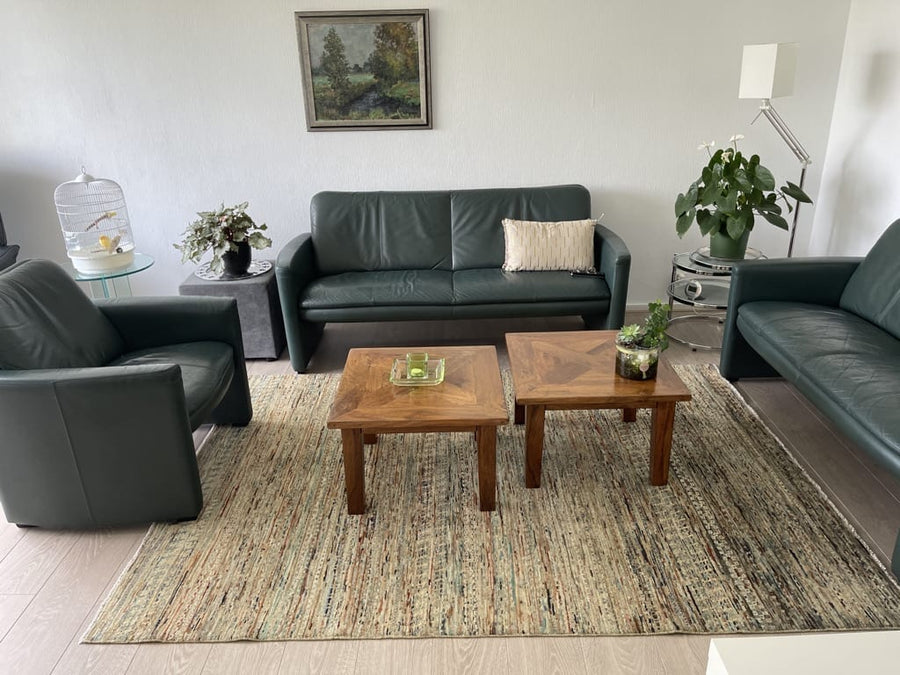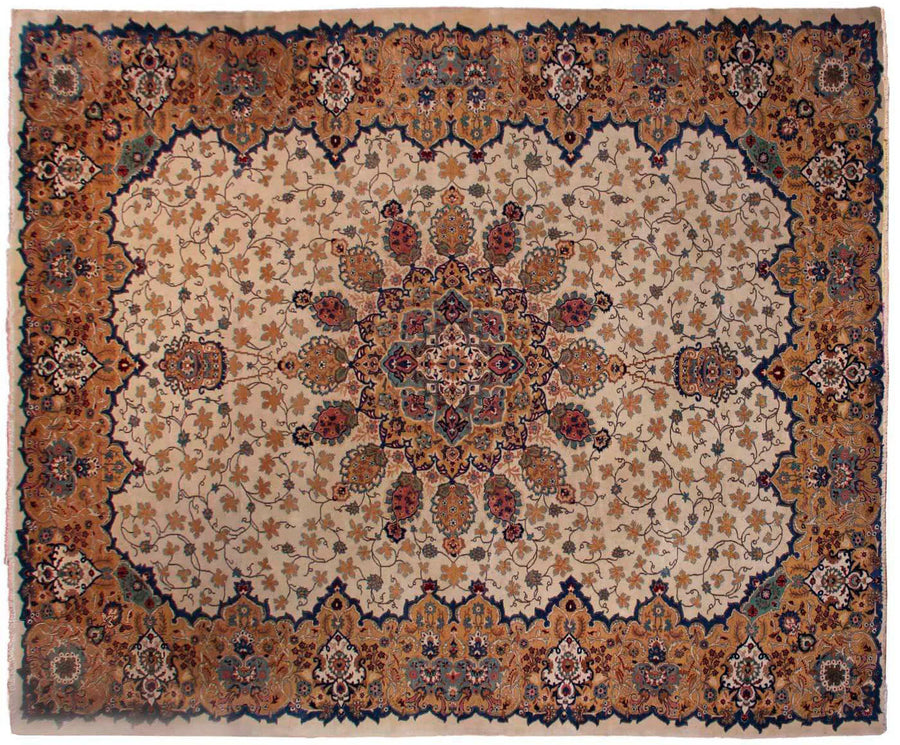


You will, of course, find 100% natural rugs at Koreman in Maastricht
Rugs come in all shapes, sizes, and materials. Koreman Exclusive Carpets sells exclusively 100% natural, hand-knotted Oriental rugs. All our rugs are made of wool and natural silk, and sometimes cotton or camel hair. The spun carpet yarn used to knot the rugs is colored with natural and vegetable dyes.


Koreman's 100% natural rugs in Maastricht are therefore of high quality. They are luxurious yet durable rugs, hand-knotted and dyed. And... they are unique. There is no second one or a copy to be found.
Why you should not want a synthetic rug
Most rugs (not Koreman's) are made of synthetic material, which is quite harmful to the environment. A synthetic rug is a machine-produced rug. These rugs consist of different layers such as a backing layer, a layer on which the carpet fibers are woven, a layer to maintain the shape of the rug, and a layer for cushioning and stability.
The backing layer of a synthetic rug is usually made of plastics such as polyester, PVC, latex, and polypropylene. And plasticizers are added to the underlay to keep the rug flexible.
The fibers of synthetic rugs are usually made of nylon, polypropylene, or polyester. To better protect the rug against moisture, dirt, and greasy substances, PFAS is used during manufacturing. This chemical substance is found, among other things, on non-stick pans and rainwear.
The colors of a synthetic rug are anything but natural. They are chemical pigments.
As if it weren't chemical enough, non-natural substances are also added to the rug to (try to) protect it against mites, moths, and molds, and aluminum hydroxide is used to ensure that the rug does not catch fire easily.
We can well imagine that with this knowledge, you would prefer to spend a little more on a 100% natural rug.
A Koreman rug is a high-quality natural product
Koreman's Oriental rugs are different from machine-made rugs. No synthetic materials are used in any rug, and no chemical substances are used during the manufacturing process. Every rug is 100% natural. And there are several reasons for this.
Firstly: Koreman's Oriental rugs are made in countries where carpet manufacturing is an ancient, respected, and creative craft. Just as rugs were made long ago in, for example, ancient Persia (now Iran), they are still made today. Moreover, the craft has evolved considerably, which benefits the result.

Secondly: The rugs are hand-knotted. For this, the carpet makers use readily available materials such as wool and silk. Using a hand loom, wool and silk are spun into carpet yarn. These yarns are colored with natural, vegetable dyes. And the result is impressive. The colors are subdued, which is pleasant for the application. The demand for brightly colored rugs is not very high.
Thirdly: Rugs made of natural materials such as wool are more resistant to moisture and dirt due to the presence of lanolin, better known as wool fat. Spilled water, etc., does not penetrate the rug but rather remains on top of it. So: no panic if a glass of red wine spills on it. Gently dab and clean with water.
Fourthly: 100% natural, hand-knotted rugs last much longer than synthetic factory rugs. Due to their compact and firm structure, they retain their shape well. You cannot wear them out of shape. And the colors also remain colorfast. A natural rug from Koreman can still look like new after 20-30 years. The purchase can certainly be called a value-retaining investment.
A natural rug: recommended for allergies
People with eczema, asthma, hay fever, and other respiratory ailments suffer from dust and dust mites indoors. The idea that rugs are breeding grounds for these is persistent.
So much so that people with such conditions don't even consider getting a rug. And that's a shame because 100% natural rugs like Koreman's actually have a positive effect on people with the aforementioned conditions.
Of course, a rug can contain dust, but it largely depends on what material the rug is made of. In addition, it is logical that the space we are in is vacuumed from time to time. Even if there is no rug or carpet in it. That's a no-brainer.
In a room with only smooth, hard floors, (fine) dust floats through the air, with all the disadvantages for people with respiratory or skin allergies. The German Allergy and Asthma Association – DAAB – has investigated and measured that the average amount of fine dust in homes with smooth floors is twice as high as in homes with carpeting or rugs.
Soft, low-pile and non-static carpets or rugs made of natural materials – such as rugs from Koreman Exclusive Carpets – absorb fine dust and dust mites, which ensures that dust no longer floats through the room, making it much more pleasant for people with respiratory problems to stay there.

A natural rug is recommended for people suffering from allergies.
Synthetic carpets, however, are static and therefore have a negative effect on fine dust. They cause so-called 'heavy air'. This is air in which dust, pollen, and dirt clump together due to static charge, causing us to inhale an even higher concentration of dirt.
Conclusion: if you suffer from a respiratory allergy, choose a 100% natural rug from Koreman in Maastricht. It is good for your well-being and health, and your interior will also look much better 😉
Natural rugs from Koreman are made ethically
Koreman's rugs are hand-knotted in various Eastern countries. Countries where not everyone is well-off, and where in some parts of, for example, India and Pakistan, there is even a lot of poverty. And poverty encourages child labor.

In the so-called 'knotting countries', the Care & Fair Organisation is active. This organization, of which Koreman Exclusive Carpets is a member, combats illegal child labor, advocates for free education, and aims to provide better health for the families of carpet knotters. Additionally, women in these countries receive more support and education, which gives them a little more independence. In short, a very noble initiative that Koreman wholeheartedly supports with financial contributions.

Photo: Care & Fair Organisation
For Koreman, rug manufacturing is certainly not a remote issue. On our travels through the Orient, where we are always looking for new rugs and where we also have our own carpet designs knotted, we always come into contact with the skilled craftsmen and women. We have come to know them as modest, hardworking, and extremely friendly people. They are people we wish a good and pleasant life. The contact with the families is always cordial and positive. Anyone who buys a beautiful and 100% natural rug from us helps these people in their existence.